



Quick Breakdown
-
Most fleet drivers are comfortable with safety technology, and 77.2% say the benefits outweigh privacy concerns.
-
Nearly 44% say dash cams or GPS data has helped them or a coworker in an accident dispute.
-
Managers explaining the "why" behind safety technology is turning the perception from surveillance to protection.
Linxup surveyed 267 commercial fleet drivers across field service industries to find out how they feel about GPS tracking, dash cams, and structured safety programs.
When your job involves driving, and often in a hurry, safety is a real priority. You have a tight schedule, one job runs into the next, and customers still expect you to show up on time no matter what traffic looks like.
For field service workers, being on the road is part of the job. But for business owners, a truck with a company logo is equal parts advertising and opportunity for a scam or disputed claim. Every vehicle in the fleet is a valuable business asset that needs protecting.
GPS tracking and AI-powered dash camerashave become standard tools for keeping an eye on day-to-day fleet operations for service businesses, and not just at companies with a dedicated fleet manager. For the owner or office manager scheduling jobs, responding to customers, and dispatching crews, that visibility can make or break the business. There's less room to absorb a bad accident, a false claim, or a driver whose habits are quietly burning through fuel.
Drivers have generally understood why these tools exist, but privacy concerns and driver resistance have been a major obstacle to implementing fleet safety technology successfully. In Linxup’s 2025 survey, 51% of managers said privacy concerns were the biggest blocker to dash cam adoption and 49% said driver resistance to new technology was their biggest challenge.
That's changing fast.
In a follow-up 2026 survey of 267 commercial fleet professionals, 77.2% of drivers say the benefits of fleet safety technology outweigh privacy or resistance concerns, and only 4.5% describe it as invasive.
Nearly 44% of drivers say they or a coworker have been involved in an accident where dash cam footage or GPS tracking worked in their favor during an insurance claim or legal dispute. Seeing those benefits firsthand when something goes wrong is changing how drivers view the technology, from something that monitors them to something that can protect them.
What do drivers think about GPS tracking and dash cams?
GPS tracking and in-cab dash cams have long been a divisive topic. Managers want to use them to protect their business and drivers aren't convinced they would serve as anything more than an unwanted babysitter. But those views are changing.
More than 81% of drivers say they like fleet safety tools or are comfortable with them, and 77.2% say the benefits outweigh concerns about privacy or driver resistance, while only 4.5% describe the technology as invasive.
The numbers suggest drivers are becoming more comfortable with GPS tracking and dash cams, especially as they see how the technology can work in their favor.
What's changing drivers' views about fleet safety technology?
There are two main factors that are changing driver’s views about fleet safety technology: drivers are seeing the technology work firsthand, and employers are doing a better job explaining why it's being used.
Drivers have proof when something goes wrong
Survey results show drivers are seeing real value from dash cams and GPS tracking data, particularly when it comes to resolving disputes. Footage and location data provide an objective record of what actually happened. That can mean proving a job was completed, disputing a false claim, or catching a staged accident before it costs the company money or the driver their job.
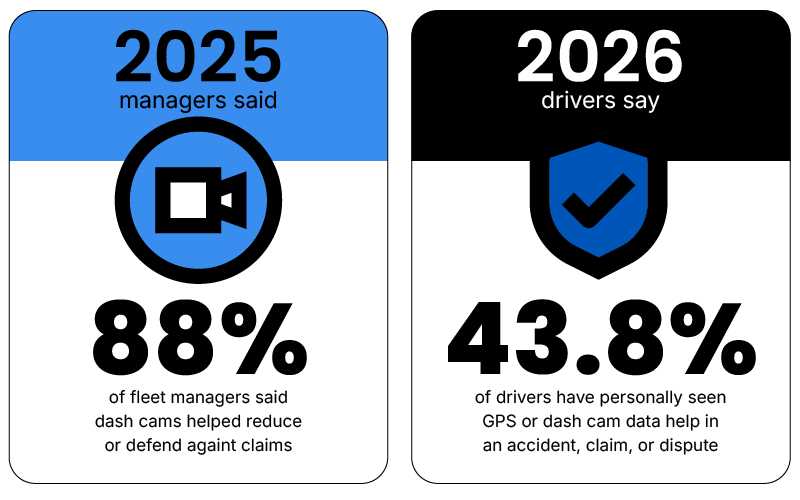
In 2025, 88% of fleet managers said dash cams helped reduce or defend against accident claims. In 2026, 43.8% of drivers say they’ve now seen it happen to them or a coworker personally. Managers saw the value from the business side and now drivers are validating it from behind the wheel.
Employers are having real conversations
Employers are also doing a better job communicating the why. More than 72% of drivers say their employer has explained, either in detail or at a basic level, how GPS tracking and dash cameras affect insurance coverage.
When drivers understand the reason behind a tool, it's easier to see it as protection rather than surveillance. When asked what matters most day to day, drivers ranked:
-
29.2% Protection if something goes wrong
-
26.6% Fewer accidents
-
25.8% Knowing the company has their back
Drivers know that spending every day on the road comes with risk. If something does happen, they want an objective record and to know their company has the information to support them. The shift in perception shows drivers are seeing how technology benefits them in real scenarios.
What motivates service fleet drivers to improve their driving?
Drivers know they're expected to drive safely, but motivating them to change their driving habits can be another story.
A clear safety policy is a good starting point. Everyone, from drivers to management, should understand what's expected and why. But creating a policy and asking a driver to sign it doesn't automatically change behavior.
Some drivers, like those that have been in the business for decades, may be slower to see the need for improvement and even see GPS tracking and dash cams as a sign of distrust. If you’ve been driving for 20 to 30 years without a serious accident, it’s easy to assume there’s not much left to learn.
But even experienced drivers have habits they can improve, and that doesn't necessarily mean they're unsafe drivers. Excessive idling, hard braking, speeding and other everyday behaviors can increase fuel use and vehicle wear even if they never lead to an accident.
So what gets drivers to pay attention? Money.
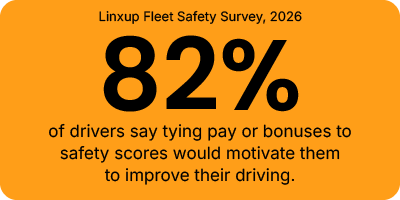
According to the survey, 82% say tying pay or bonuses to safety scores would motivate them to improve their driving performance. Cash bonuses were the top motivator at 30.7%, ahead of gamification, recognition, and competition. Nearly 20% say nothing would motivate them because they’re “already as safe as they can be.”
Recognition and friendly competition can still help, but the survey shows a direct financial incentive has the strongest pull.
It also gives safety scores and driver leaderboards a clearer purpose. Instead of feeling like another number management uses to grade them, drivers have something they can actively improve and benefit from.
Can a strong safety culture help retain drivers?
Hiring and retaining good field service workers isn't easy. Safety may be one more reason good employees decide to stick around.
In 2025, 59% of managers said safety had shifted from being an expense to a recruiting tool. In 2026, drivers are echoing those thoughts. More than 75% of drivers say how their employer handles safety affects their decision to stay. Of those, 43.8% say a strong focus on safety makes them more likely to stay with the company, while another 31.8% say it makes them somewhat more likely to stay.
Employees want to know their company values their well-being, not just how many jobs they can finish in a day. A safety program can reinforce that message.
Customers are noticing, too. More than 61% of drivers say customers have mentioned company safety practices as a reason for doing business with them. And 41.6% say their employer has gotten more serious about safety in the past year.
Safety isn't just a compliance exercise or a way to reduce claims. It can influence how employees feel about the company and how customers view the business.
What gets in the way of safer driving?
Keeping drivers on schedule while keeping them safe is a constant balancing act. Operational demands often ask drivers to do more, and do it faster, to squeeze more jobs into a day.
Nearly 45% of drivers say real-world pressures sometimes make efficient driving difficult, while another 28.5% say tight schedules often make it difficult. Altogether, more than 73% face that conflict at least some of the time.
If you're telling a technician not to speed but giving them a schedule they can't realistically keep without rushing, that's a mixed message.
Drivers take some responsibility for the problem. Almost 42% say drivers don't always take safety rules seriously. But leadership doesn't get a pass either. About 22.5% say management sets safety rules but doesn't follow through, while another 22.5% say rules only change after something has already gone wrong.
A safety policy only works when expectations are realistic and consistently enforced. Management needs to lead by example, follow through on the policies it sets, and make sure operational demands don't undermine those expectations. Policies are more likely to stick when they’re explained, discussed, and revisited so drivers understand the reasoning behind them.
Do formal fleet safety programs make a difference?
Having GPS trackers and dash cameras is one thing. Having a formal safety program around them is another. The survey shows that companies with formal programs are more likely to make safety a visible priority, regularly monitor risk, and give drivers feedback.
The difference starts with how employees view their company's commitment to safety. 86.2% of employees at companies with formal programs say their employer treats safety as extremely important, compared with 62.5% at companies building a program, and 49% at companies with informal safety practices.
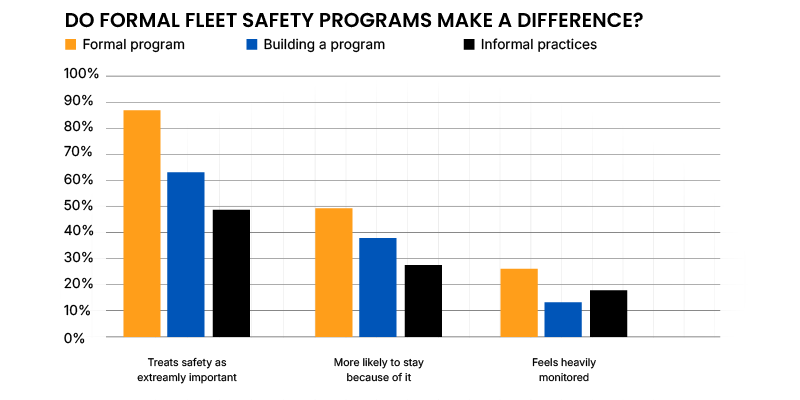
Formal safety programs also have a stronger connection to employee retention. 49.3% of employees with a formal safety program say a strong focus on safety makes them more likely to stay, compared with 37.5% at companies building a program, and just 27.5% at companies with informal practices.
Getting management feedback is where the gap is most significant. In 2025, 40% of managers said they weren’t giving regular driver performance feedback. However, in 2026, 43.1% of drivers say they receive feedback monthly or quarterly, and another 22.5% receive feedback weekly. Still, 22.1% say they want more feedback than they're currently getting.
Technology adoption follows a similar pattern. Among companies with formal safety programs:
-
80.3% use GPS tracking
-
68% use dash cameras
-
70.4% closely track both accidents and near misses
-
46.3% provide safety feedback regularly
By comparison, 60.8% of companies with informal safety practices use GPS tracking and 47.1% use dash cameras. Only 37.3% closely track accidents and near misses, while 41.2% track accidents but ignore near misses.
The findings from companies without a safety program are also telling. None said their employer treats safety as extremely important, and 60% said safety isn't a priority. All fleet drivers that responded said they never receive safety feedback, even though 60% want it, and 80% said they have no formal way to report a fleet safety concern.
They were also the most likely to feel like technology was being used as surveillance. Sixty percent of respondents without a safety program say GPS tracking or dash cameras make them feel heavily monitored, compared with 25.6% at companies with formal programs, 17.6% with informal practices and 12.5% at companies building a program.
Installing a camera or GPS tracker alone doesn't create a safety culture. Regular feedback, clear expectations, and consistent follow-through help drivers see the technology as a tool to support their safety rather than simply another way to watch them.
How are fuel costs changing driver behavior?
Fuel costs add another layer of pressure for service businesses trying to keep operating costs under control. More than 53% of drivers say they've changed how they approach routes or scheduling because of fuel costs. Nearly 30% say they're combining trips, while another 24.3% report stricter vehicle-use policies.
Drivers are paying attention, too. More than 83% say they're at least somewhat aware of their own fuel consumption as part of the job. But knowing how much fuel you're using and having the ability to reduce it aren't always the same thing. More than 73% say job pressure makes efficient driving difficult at least some of the time.
For a technician trying to make the next appointment on time, the immediate priority may be getting to the customer, not maximizing fuel efficiency.
Fleet data can help identify the areas drivers have more control over, such as excessive idling, speeding, or inefficient routes. Instead of simply telling drivers to use less fuel, managers can give them something specific to work on.
Women are the strongest advocates for fleet safety
Both men and women see value in fleet safety technology, but they don't always value the same benefits.
The differences are especially noticeable in two areas:
-
Protection: 41.2% of women rank protection if something goes wrong as a top priority, compared with 27.5% of men.
-
Overall acceptance: 91.2% of women say the benefits of fleet safety technology outweigh privacy or resistance concerns, compared with 75.1% of men.
Women rank better driver accountability as their top benefit at 64.7%, with dispute resolution also ranking highly. Men rank safer driving habits as their top benefit at 64.7%, followed by reduced speeding.
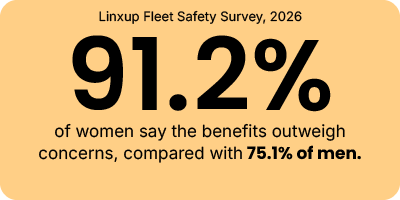
While the divide is evident, men and women don’t need completely different safety programs. Instead, this is an indicator to managers that how they deliver the value depends on the priorities of their audience. For some, protection and accountability may resonate more, while safer driving habits or reduced speeding may connect more with others.
How does fleet safety perception differ by industry?
The differences become even more noticeable when you look at the type of work drivers are doing. Each trade has different schedules, vehicles, customer expectations and day-to-day risks.
Electrical services
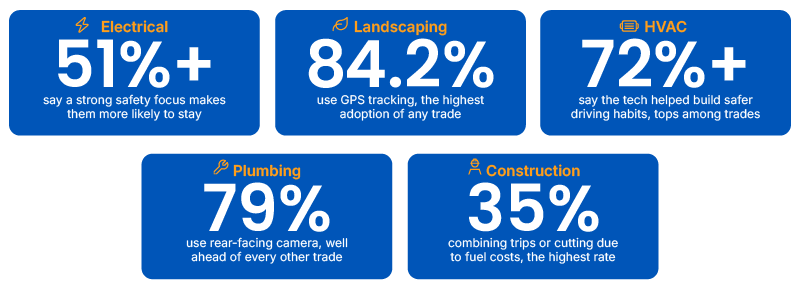
Electrical services show the strongest connection between safety and employee loyalty. More than 51% of electrical workers say a strong focus on safety makes them more likely to stay, compared with 34.9% in HVAC and 35.7% in plumbing.
Electrical drivers also report the highest rate of dash cam or GPS footage working in their favor during an accident dispute, at 70.3%. Landscaping follows at 63.2%, construction at 57.6%, plumbing at 50% and HVAC at 48.9%.
For electrical businesses, the connection between safety and retention is hard to ignore.
Landscaping
Landscaping leads the major trades surveyed in technology adoption, with 84.2% using GPS tracking and 73.7% using dash cameras. But landscaping drivers don't necessarily prioritize the same benefits as other trades. More than 42% say knowing the company has their back would make the biggest difference in their day-to-day work. Only 10.5% chose protection specifically.
For crews moving from property to property all day, support from the company may resonate more than the technology itself.
HVAC
HVAC drivers report some of the strongest behavior changes associated with safety technology. More than 72% say the technology has helped create safer driving habits, the highest rate among the major trades surveyed. But only 34.9% say a strong focus on safety makes them more likely to stay with their employer.
Technology can help change driving habits without necessarily changing how an employee feels about the company. The larger safety culture still plays a role in whether those improvements translate into employee loyalty.
Plumbing
Plumbing is seeing one of the biggest shifts toward safety. Nearly 64% of plumbing respondents say their employer has gotten more serious about driver safety in the past year, well ahead of the other major trades surveyed.
The challenge is follow-through. More than 35% say management sets safety rules but doesn't always follow through, also the highest rate among the major trades.
Plumbing also leads by a wide margin in rear-facing camera use. Nearly 79% of plumbing respondents report using them, compared with less than half in HVAC, construction, landscaping and electrical.
For plumbing businesses investing more heavily in safety, consistent follow-through may be the next opportunity.
Construction
Construction drivers feel the connection between safety, fuel costs, and customer expectations more directly than most. Nearly 35% say they've been asked to combine trips or reduce driving because of fuel costs, the highest of the major trades. And 31.6% say customers regularly bring up safety practices as a reason for doing business with them.
Construction companies are also the most likely to explain the insurance connection. More than 48% of construction workers say their company has explicitly tied safety rules or technology to insurance costs.
For these businesses, the connection between driver behavior, operating costs, insurance, and customer perception is especially visible.
Turning driver buy-in into better fleet safety
Drivers and business owners may be more aligned on fleet safety than either side realizes. Both want fewer accidents, protection when something goes wrong, and an objective record of what actually happened.
The survey also makes it clear that simply installing GPS tracking or dash cams isn’t enough. Driver buy-in depends on how management is explaining the why behind the technology, tying performance to real incentives, and following through on the policies they put in place. Drivers need realistic expectations, regular and consistent feedback for safety programs to work.
The Linxup fleet safety industry survey was conducted in June 2026 among 267 field service professionals across commercial fleets in HVAC, electrical, landscaping, plumbing, and other field service industries.
Methodology
This survey was conducted by Centiment on behalf of Linxup in June 2026. It is based on a survey of 267 field service professionals who are part of a commercial fleet in the United States.